
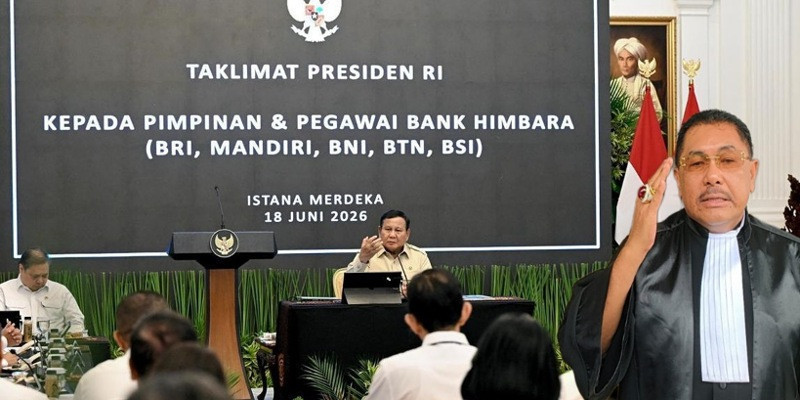
ASKARA - Chairman of the Legal Aid Institute (LBH) of Gerakan Kristiani Indonesia Raya (GEKIRA), Dr. Santrawan T. Paparang, S.H., M.H., M.Kn., stated that President Prabowo Subianto’s legal policy direction in the financial services sector reflects the government’s commitment to building a stronger, more inclusive, and more resilient national financial system amid growing global economic uncertainty.
According to Santrawan, the financial services sector has become one of the key pillars supporting national economic growth. Therefore, legal certainty, regulatory consistency, consumer protection, and institutional integrity must serve as the foundation for sustainable development in banking, capital markets, insurance, pension funds, financing institutions, and the rapidly growing digital financial ecosystem.
“President Prabowo’s administration understands that a healthy financial system is not merely an economic instrument. It is also a strategic tool to promote public welfare, encourage investment, support business expansion, create jobs, and strengthen national economic sovereignty,” Santrawan said in Jakarta.
He explained that Indonesia currently faces various challenges in the financial sector, ranging from cybercrime, illegal online lending, digital fraud, money laundering, and financial technology disruptions to the need for broader access to financial services for underserved communities.
For this reason, he emphasized that the government’s legal policies must be directed toward creating a balanced framework that encourages innovation while ensuring legal protection and effective supervision.
“The law must not become an obstacle to innovation. At the same time, innovation cannot be allowed to grow without adequate legal safeguards. A balance between economic development and legal certainty is essential,” he said.
Santrawan praised efforts to strengthen the role of financial regulators and supervisory institutions in maintaining financial system stability. He noted that coordination among state institutions, including the Financial Services Authority (OJK), Bank Indonesia, the Deposit Insurance Corporation (LPS), law enforcement agencies, and relevant ministries, is crucial to mitigating systemic risks and protecting public trust.
He further stressed that consumer protection should remain a central pillar of financial sector reform. As financial products and services become increasingly sophisticated, citizens must be protected from unfair practices, misleading information, and fraudulent schemes.
“Financial literacy and consumer protection are inseparable. The government must continue to improve public awareness while ensuring that legal remedies are accessible to individuals who become victims of financial misconduct,” he explained.
Regarding digital transformation, Santrawan highlighted the importance of developing a robust legal framework capable of accommodating technological advancements, including digital banking, financial technology (fintech), artificial intelligence, blockchain applications, and digital payment systems.
According to him, technological progress presents tremendous opportunities to accelerate financial inclusion, particularly for communities in remote and underserved regions. However, it also introduces new legal challenges related to data protection, cybersecurity, digital identity, and cross-border financial transactions.
“Indonesia needs a forward-looking legal framework that can anticipate future developments. Regulations must provide certainty without limiting technological progress and business innovation,” he said.
Santrawan also underlined the importance of combating financial crimes through stronger law enforcement mechanisms. He called for strict action against illegal financial activities, including fraudulent investment schemes, illegal lending platforms, market manipulation, corruption, and money laundering.
“The principle of equality before the law must be applied consistently. No individual or institution should be immune from legal accountability when violating regulations that harm the public and undermine financial system integrity,” he emphasized.
Furthermore, he expressed support for policies aimed at expanding access to financing for micro, small, and medium enterprises (MSMEs), which remain the backbone of Indonesia’s economy. He argued that legal reforms should facilitate broader access to capital while maintaining prudent risk management standards.
“Financial inclusion is not merely about opening bank accounts. It is about ensuring that citizens and entrepreneurs have meaningful access to financing, savings, investment opportunities, and financial protection that can improve their quality of life,” he stated.
Santrawan added that President Prabowo’s vision of achieving Indonesia Emas 2045 requires a modern and resilient financial ecosystem supported by strong legal institutions, transparent governance, and public trust.
“The future of Indonesia depends not only on economic growth figures but also on the strength of its legal and institutional foundations. A credible financial system requires laws that are fair, transparent, adaptive, and consistently enforced,” he said.
In closing, Santrawan called upon all stakeholders, including regulators, financial institutions, business actors, academics, and civil society, to work together in supporting legal reforms that strengthen the financial services sector and promote sustainable economic development.
“When legal certainty, institutional integrity, financial innovation, and consumer protection move hand in hand, Indonesia will possess a financial system capable of supporting long-term prosperity and national resilience. This is the direction that should continue to guide President Prabowo’s legal policy in the financial services sector,” he concluded.
